
Performance tip for Young Singers – Fauré’s mélodie, Après un rêve

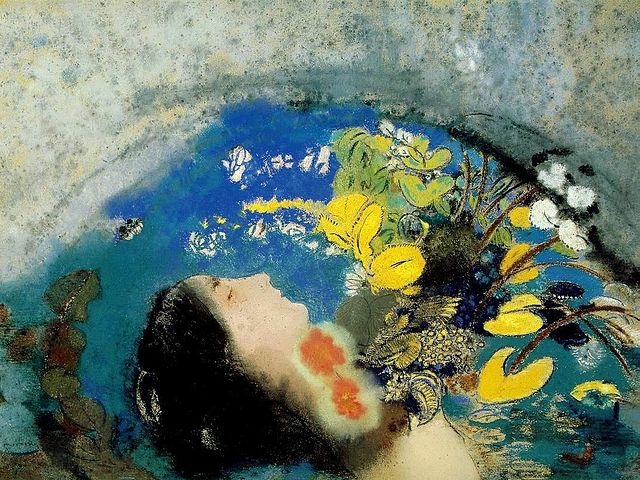
Odilon Redon Opehlia “Among the Flowers”

Young singers often make the mistake of applying what they assume is a style to a song because of the period that it is from, for instance here, the late Romantic period, or they have heard a singer’s recording that is idiosyncratic. Sometimes a student might have a score that is a “student edition” (i.e. cheap), or perhaps more nicely put, less than an Urtext edition. Good news! There is a brand-new five-volume set of the complete songs and vocalises of Gabriel Fauré, by Roy Howat and Emily Kilpatrick. It is the only complete critical edition and based on the study of hundreds of manuscript and printed sources.

But back to style, it is important to learn what the composer wanted in the performance. A little research goes a long way!

In their article, “Editorial Challenges in the Early Songs of Gabriel Fauré,” published in the Music Library Association’s Notes publication, Vol. 68, No. 2 (December 2011), Howat and Kilpatrick remark:

Witness accounts of Fauré’s playing and interpretative wishes convey a matching assumption of forward motion, along with a distaste for any gratuitous slowing, rubato, or any sort of sentimental affectation. When the mezzo-soprano Claire Croiza asked him how he wanted “Après un rêve” to be sung (after they had heard an exaggeratedly languorous performance), he [Fauré] replied simply “Sans ralentir, sans ralentir, sans ralentir.” (Without slowing down.)

This is not to say that interpretation by an artist is not allowed. Study the text intensely. Make a word-for-word translation – don’t make it fancy or poetic – so that you know what each word means and what you are singing about. Speak the text slowly and deliberately many times and then begin to speak the text in rhythm. While this might seem tedious, the end result will be that you become organically enmeshed in the text as well as in the notes. It is only then that “interpretation” has its genesis.

Pierre Bernac, arguably the most renowned interpreter of the French Art Song (Mélodie), talks about performance and interpretation in his seminal book, “The Interpretation of French Song,” saying:

A work of music – which is a creation in time, as opposed to a work of plastic art, which is a creation in space – comes into actual existence through the performance of the interpretative artist; but unless the work is an improvisation of the artist, it is necessarily the performance of a work already conceived by the composer and notated on paper. The signs penned on paper, however, are mere symbols; the actuality of the sound is totally absent from them. In the art of music, it is the interpreter’s performance which we come to regard as the work itself. … But conscientious performers know well how difficult it is [to observe this scrupulous accuracy, this precision.] There are so many things to be observed: indications of tempi, precision of rhythm, of value (values of the notes, values of the rests), the accents, the dynamics, the phrasing, the nuances, etc. It can be said that one never reads the score with sufficient care.

Of “Après un rêve,” Bernac says:

The purists may think that the accompaniment of this mélodie is too simple, with its repeated chords; but the harmonies are refined and support the most exquisite melodic line which, with its apparent Italian facility, never loses its serene loftiness. This is enough to indicate to the singer that, although he has to sing this mélodie with a true and beautiful bel canto line, his style must be always perfectly controlled.

With all of this in mind, listen to the BabelGuide of “Après un rêve,” beautifully recited by Raphaël Treiner, with a word for word translation and IPA transcription by Bénédicte Jourdois.

Available for sale through the SingersBabel website or app, or by subscription. https://www.singersbabel.com/marketplace/ProductDetail.aspx?pid=2924&sch=Apr%c3%a8s%20un%20r%c3%aave

Resources:
Gabriel Fauré “Complete Songs,” Volume 1 (34 Songs), edited by Roy Howat and Emily Kilpatrick, available through Classical Vocal Rep
http://www.classicalvocalrep.com/products/Gabriel-Faure-Complete-Songs-Volume-1-34-Songs-High-Voice-205406.html

Pierre Bernac, “The Interpretation of French Song”
https://www.amazon.com/Interpretation-French-Norton-Library-Paperback/dp/0393008789

Text and Translation: http://www.lieder.net/lieder/get_text.html?TextId=18170
Thoughts on Mahler’s “Urlicht”

BACKGROUND: SingersBabel recently recorded the German texts to Mahler’s Sinfonie No. 2, “Die Auferstehen” (“The Resurrection”) to prepare a BabelGuideTM for singers (soloists and choristers) who want to perfect their German pronunciation of this work. BabelGuidesTM are mp4 files consisting of a 3-line scan of texts: the original text is in the middle, a word-for-word English translation is above, and an IPA (International Phonetic Alphabet) transcription is below. As the text scrolls by, one hears a native speaker/sung diction specialist (in this case, the lovely German soprano Christine Reber) recite the text in a poetic reading and also in a slow version. Here is a link to a sample BabelGuide of Mahler’s Urlicht.

TODAY’S THOUGHTS: One could write reams on Mahler’s Sinfonie No. 2 from every possible standpoint of text and music, but I leave that to others infinitely more knowledgeable than I. My random thoughts today are on the fourth movement, Urlicht [Primal Light], which is sung by the alto soloist. The text comes from poems from Des Knaben Wunderhorn [The Youth’s Magic Horn], a collection of anonymous German folk poems assembled by Achim von Arnim and Clemens Brentano. Mahler set some 24 of these, in both orchestral and voice and piano settings. Urlicht is an art song, really, but with an expanded orchestral palette and serves as an introduction to the fifth movement, the finale or Resurrection.

„Urlicht“ “Primal Light”
O Röschen rot! O little red rose!
Der Mensch liegt in grösster Not! Humankind lies in greatest need!
Der Mensch liegt in grösster Pein! Humankind lies in greatest pain!
Je lieber möcht’ ich im Himmel sein! Much rather would I be in Heaven!
Da kam ich auf einen breiten Weg; Then I came onto a broad path;
Da kam ein Engelein und wollt’ mich abweisen. And an angel came and wanted to turn me away.
Ach nein! Ich liess mich nicht abweisen! But no, I would not be turned away!
Ich bin von Gott und will wieder zu Gott! I am from God and would return to God!
Der liebe Gott wird mir ein Lichtchen geben, The dear God will give me a little light,
Wird leuchten mir bis in das ewig selig Leben! Will light me to eternal, blissful life.

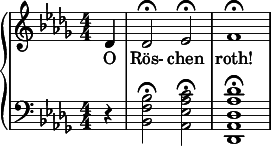
I am quite taken by the exquisite first words uttered, “O Röschen rot!” and how Mahler sets them. The key is D-flat major (far remote from the c-minor key of the 3rd movement), the time signature a mixture of 4/4 and 3/4, the tempo indication Sehr feierlich, aber schlicht. Choral-mässig. [Very solemn, but simple. Hymnlike.] The alto soloist begins the movement (terrifyingly) by herself, alone on a low d-flat pick-up quarter note, with the word, “O”…, repeats the d-flat half note on the downbeat of the next measure with “Rös-,” moves to an e-flat half note “chen,” and then on to a miraculous f with “rot!” (“roth” is an old German spelling). It is the first emergence of the human voice heard in the symphony, the ultimate expression of human emotion and spirit. She is accompanied, after that initial isolated first note, by muted strings clustered about her.  I can only imagine the intense concentration and courage it takes the singer to begin that movement.

opening measures

And what of the little red rose? A symbol of purity, heavenly perfection, earthly passion, life and death. In ancient Rome, roses were grown in funeral gardens to symbolize resurrection. In Christian art, the red rose was a symbol for martyrdom. The rose is often a symbol for the Virgin Mary, who is called “a rose without thorns” as she was free from original sin. St. Ambrose’s legend says that the rose grew, without thorns, in the Garden of Eden. After the Fall, it became an earthly plant and thorns appeared as a reminder of our sins and fall from grace. The scent remained to remind us of the lost perfection of Paradise. The rose is even a symbol for Christ, as seen in the 15th-century German Christmas song, Es ist ein ‘Rose’ entsprungen [Lo, how a Rose e’er blooming]. My favorite contemporary setting is Craig Hella Johnson’s creative pairing of Praetorious’s Lo, how a Rose and Amanda McBloom’s The Rose, found here, beautifully performed by the University of Utah Singers, conducted by Brady Allred. “Just remember in the winter, far beneath the bitter snows, lies the seed that with the sun’s love in the spring, becomes the rose.”

But back to Mahler and Urlicht – after the exquisite first statement enters a stately brass chorale of 3 trumpets in F and 4 horns in F, 2 bassoons and a contrabassoon, marking that the preparation for the resurrection has begun. The lowest in pitch, the contrabassoon, enters at the penultimate measure in a descending V-I chord progression to the tonic D-flat. (Note that the contrabassoon sounds one octave lower than written. Here it settles the entire chorale as if an anchor for the largest ship ever.)Kontrabassoon IV Urlicht

The next section, “Der Mensch liegt in grösster Not! Der Mensch liegt in grösster Pein!” [Humankind lies in greatest need … in greatest pain] is again accompanied by the muted strings, with two trumpets which echo “in grösster Pein,” and followed by a quintessential Mahler melodic setting of “Je lieber möcht’ ich im Himmel sein!” [Much rather would I be in Heaven!] An oboe discreetly sings with the alto on the repeat of the phrase, moving ahead in an achingly expressive tonic chord which barely resolves because of the predominance of open 5ths, creating a unease which wants to move ahead. It indeed does, this time in b-flat minor for a wary “Da kam ich auf einen breiten Weg” [Then I came onto a broad path] accompanied by oboe, horns, harps, glockenspiel, and the 1st clarinet, which plays a series of tripled eighth notes and a half, which are then repeated by the 2nd clarinet an octave lower, while an unmuted solo violin speaks of – eternity?

IMSLP43274-PMLP49406-Mahler-Sym2.Clarinet-ed

IMSLP43282-PMLP49406-Mahler-Sym2.Violin1-ed

Then an angel arrives, “Da kam ein Engelein und wollt’ mich abweisen” [And an angel came and wanted to turn me away] via bright modulation to A major and the violin theme is repeated by the flute. The angel propels her to a delicately passionate defiance, “Ach nein! Ich liess mich nicht abweisen!” [But no, I would not be turned away!]. The oboes bring her to the astonishing statement “Ich bin von Gott und will wieder zu Gott!” [I am from God and would return to God!] and “Der liebe Gott wird mir ein Lichtchen geben” [The dear God will give me a little light] modulates spiritually and moves again slowly, as in the beginning with “Wird leuchten mir bis in das ewig selig Leben!” [will light me to eternal, blissful life!]. On the word “ewig” [eternal] we arrive back in D-flat major, and move directly into the 5th movement.

Here are two recordings of Urlicht I particularly esteem, of two different generations and nationalities – the great German mezzo-soprano Christa Ludwig, with the Wiener Philharmoniker at the Salzburg Festival in 1989, conducted by James Levine – and the late, great American mezzo-soprano Lorraine Hunt Lieberson, in a live recording with the San Francisco Symphony Orchestra in 2004, conducted by Michael Tilson Thomas.

Mahler completed Urlicht on July 19, 1893 at his composing hut in Steinbach am Attersee, Austria.

Mahler composing hut

A full score of the movement can be found below as well as the original manuscript in Mahler’s hand here.

IMSLP21507-PMLP49406-Mahler_-_Symphony_No._2_-_IV._Urlicht_(orch._score)